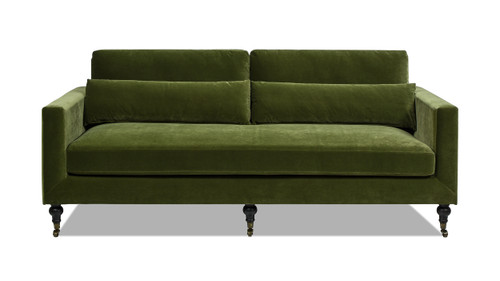
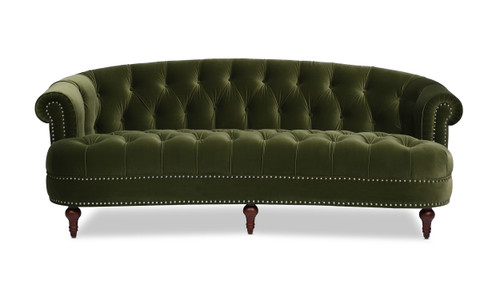
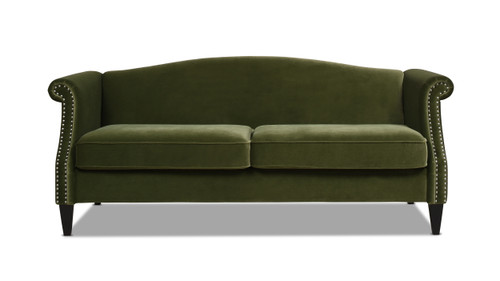
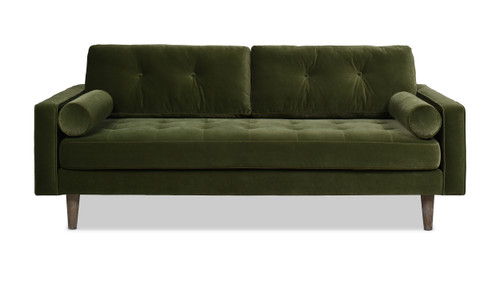
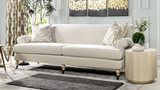
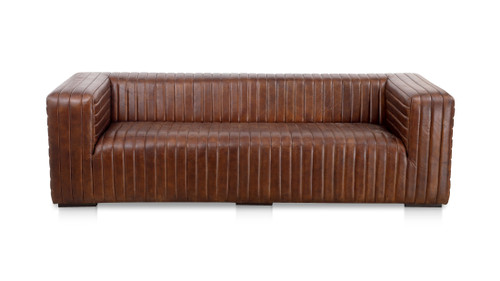
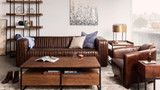
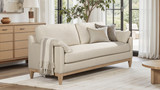
A sofa is the piece a living room organizes itself around. It
sets the proportion of the space, establishes the register — tailored or
relaxed, traditional or modern — and absorbs more daily use than anything else
in the room. This guide covers the decisions that matter, in the order they
matter: how you'll use it, how big it should be, how it should feel, and what
it's made of.
Start with how you'll actually use it
Before style or fabric, decide what the sofa is for. A piece that anchors a
family room where people eat, nap, and watch television has different
requirements from one in a formal sitting room used mainly for conversation.
Daily-use sofas want durable performance upholstery, removable covers, and a
seat that stays comfortable for hours. Occasional-use pieces can prioritize
silhouette and texture — a more delicate fabric or a sculptural shape earns its
place when it isn't absorbing daily wear. Households with children or pets
should treat fabric durability as a starting constraint rather than a
late-stage preference.
Measure twice: the room and the route
Two measurements decide whether a sofa works. The first is the room. The
second is the path the sofa has to travel to reach it — and that one causes far
more failed deliveries than people expect.
Sizing to the room
A useful starting point is the two-thirds rule: your sofa should occupy
roughly two-thirds of the wall it sits against. That keeps the piece
proportional without leaving the wall looking sparse or crowded.
From there, plan the negative space around it. Leave about 18 inches between
the sofa and the coffee table — close enough to reach comfortably, far enough
to walk past. Allow 30 to 36 inches for main walkways around the seating group.
If the sofa floats away from the wall, leave a few inches behind it so it reads
as intentional rather than crowded.
A low-cost way to test this before ordering: outline the sofa's footprint on
the floor with painter's tape and live with it for a day. Walk the room, sit in
the adjacent chairs, and see whether the traffic paths still work.
Measuring the delivery path
Measure every doorway, hallway width, stair turn, and — if applicable —
elevator interior along the route. Compare against the sofa's packaged
dimensions, not just its finished dimensions.
The tightest constraint is usually a doorway taken at an angle. As a rough
guide, a sofa will generally clear a doorway if its diagonal depth — measured
from the top back corner to the bottom front corner — is less than the door
opening. Removable legs help; so do designs that ship in pieces.
If your access is genuinely difficult, a modular design solves the problem
outright. Our Marcel collection ships flat and assembles in the room with
ring-and-carabiner hardware, so no single piece has to make the turn.
Sofa styles and what distinguishes them
The shape of the arms and back does most of the stylistic work. Understanding
a handful of silhouettes makes the whole category easier to navigate.
Chesterfield
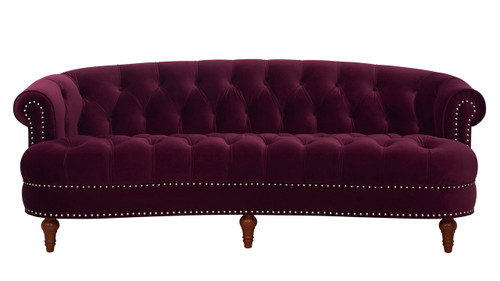
Deep button tufting, high rolled shelter arms level with the back, and often
nailhead trim. Formal, architectural, and substantial — a Chesterfield reads as
a statement rather than a background piece. Our La Rosa and Alto collections use
hand-covered buttons in matching upholstery, pulled deep, with bronzed nailheads
set individually.
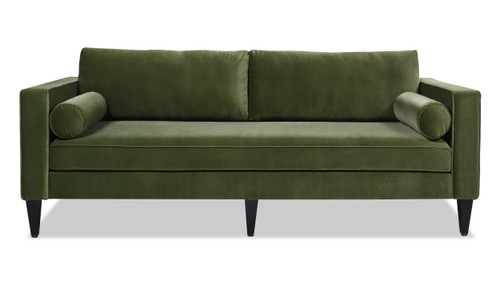
Tuxedo
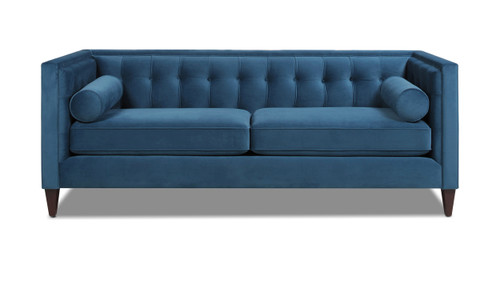
Arms and back at the same height, producing a squared, graphic profile.
Cleaner than a Chesterfield but still tailored, which makes it a good fit for
transitional rooms. The Jack collection is our version, with tapered wood legs
and button tufting.
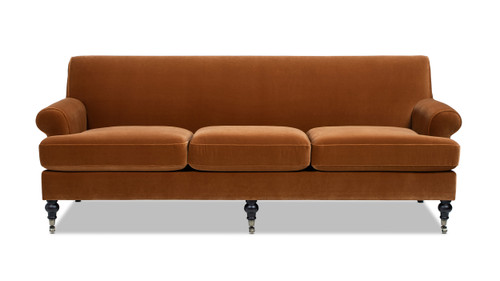
Lawson
Gently rolled, recessed arms set lower than the back, with a softer overall
posture. Comfortable and less formal — the everyday sofa shape. Our Alana
collection is a Lawson with a tight back, available in two- and three-cushion
configurations.
Mid-century modern
Low profile, slim track arms, tapered or splayed legs, minimal ornament.
Works well in smaller rooms because the visual weight sits low. Nicholi and
Nicholas are our mid-century silhouettes.
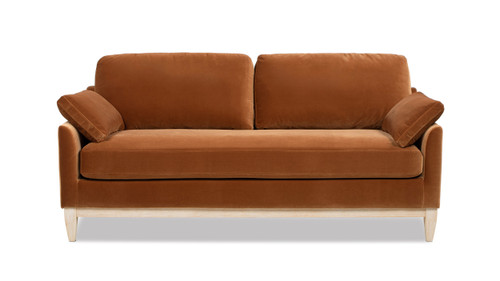
Modern farmhouse
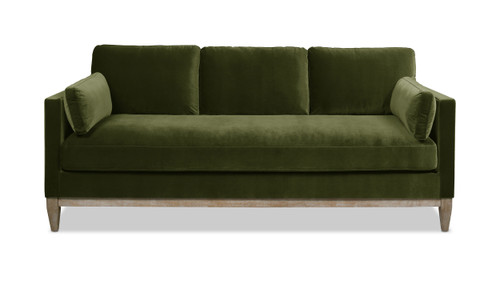
Upholstered seating paired with an exposed natural wood base, combining
warmth with a lighter visual footprint than a fully upholstered frame. Knox and
Pasadena follow this approach.
Modular
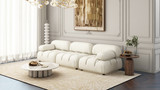
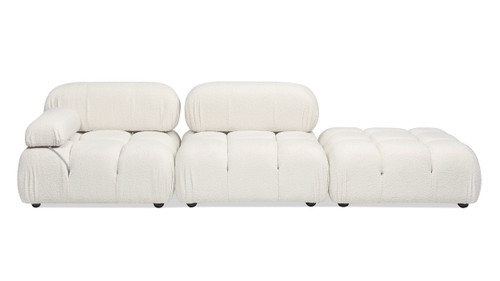
Seats, backs, and arms that reconfigure. The right answer for rooms that
change use, for renters who'll move, and for difficult delivery access. Marcel
rearranges into a long three-seater, a loveseat with ottoman, a compact
sectional, or a chair-and-chaise pairing; Sorrento offers a simpler two-piece
format with a high back built for leaning.
Contemporary and sculptural
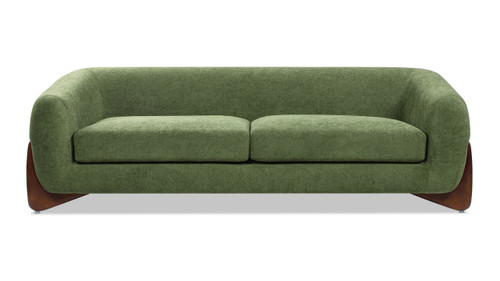
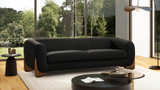
Newer silhouettes trade tailoring for shape. Mason's curved, arched arms add
an architectural line; Sharon's flange-seam puffy arms and Alpine's rounded,
oversized form read soft and enveloping. These work best where the sofa is meant
to be the focal point.
Comfort: seat depth, back style, and cushion fill
Comfort is not one variable. Three separate decisions determine how a sofa
feels to sit in, and they can be mixed independently.
Seat depth
Deeper seats — roughly 23 inches and up — invite lounging, curling up, and
lying down. They suit casual rooms and taller sitters, but can leave shorter
sitters without back support unless pillows fill the gap. Shallower seats sit
more upright, read tailored, and are better for conversation and formal
rooms.
Back style
A tight back is upholstered directly over the frame: crisp,
structured, and low-maintenance, since there's nothing to fluff. A
pillow back or loose-cushion back is softer and more relaxed,
but needs occasional straightening to look its best. Some designs use removable
back cushions that reveal a deeper seat when taken off.
Cushion configuration and fill
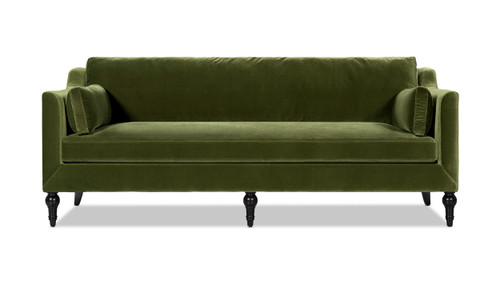
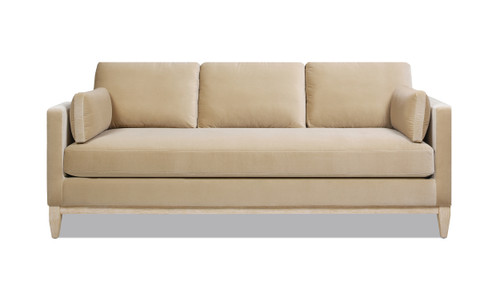
A bench seat — one continuous cushion — gives a clean,
uninterrupted line and no crevices, though it can't be rotated. Individual
cushions offer more defined structure and can be flipped and rotated to wear
evenly, which extends their life.
Fill determines the sit. High-density foam is supportive and holds its shape.
Feather-wrapped foam adds a plush, down-like surface over a resilient core —
the softer look, with more upkeep. Multi-layer foam constructions blend
densities to hit a specific firmness. Our Knox collection uses feather-wrapped
foam over a foam core; Marcel layers multiple foam densities.
Upholstery: choosing the right material
Fabric affects appearance, feel, durability, and cleaning — and it's the
hardest decision to reverse.
Performance velvet
Velvet's depth of color and subtle sheen, engineered to resist stains and
abrasion. Our most widely used upholstery, and the default recommendation for
households with children or pets. Durability is measured in double rubs; our
Mason collection's velvet is rated to 30,000 double rubs, which is well into
heavy-duty territory for residential use.
Chenille
A soft woven texture that's durable and pet-friendly, with more visual
subtlety than velvet. Used on Sharon and Sorrento.
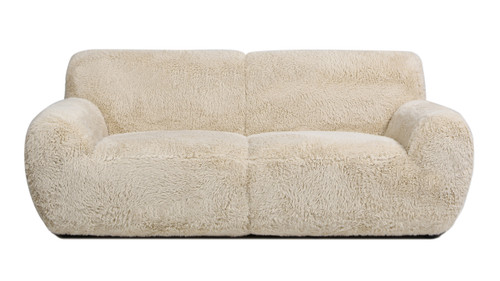
Bouclé and sherpa
Looped, textural fabrics that read casual and tactile. They suit rounded,
oversized silhouettes — Alpine pairs a faux sherpa bouclé with a low, curved
shape.
Corduroy
Visible wale and a retro register. Offered on Marcel, where the ribbing
emphasizes the modular seat blocks.
Faux fur
The most tactile option we carry. Summit's dyed long-hair sheepskin is a
focal-point material — striking in the right room, overwhelming as a
background piece.
A note on ordering swatches
Screens misrepresent color, and texture doesn't photograph. If you're
deciding between two finishes, order swatches and look at them in the actual
room, in daylight and under lamplight. It's the single highest-value step in
the whole process.
Construction: what you can't see
Frame and suspension determine whether a sofa still sits well in ten years.
They're also the hardest things to evaluate from a photograph, so it's worth
knowing what to ask.
Frames
Look for solid wood. Kiln-dried is the term that matters:
drying removes moisture from the timber so the frame resists warping,
shrinking, and joint movement as humidity changes. Our frames use kiln-dried
hardwood, solid oak, eucalyptus, rubberwood, or birch depending on the
collection.
Suspension
The support system under the seat cushions. Sinuous springs
— S-shaped steel wires running front to back — give even, resilient support
across the seat deck without the depth a coil system requires, which is why
they're standard across our seating.
Weight capacity
A practical durability signal. Our sofas start at 600 pounds and reach 900 on
Mason and 1,200 on the Marcel modular system.
Removable covers
Cushions and covers that come off are easier to clean and easier to rotate,
which meaningfully extends the life of the piece. Most of our collections offer
removable, reversible cushions.
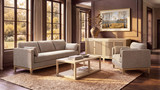
Building a complete seating group
Many of our sofas belong to full collections that include a matching
loveseat, armchair, and in some cases a sectional — Jack, Alana, La Rosa, and
Knox among them.
Matching within a collection produces a cohesive, resolved room. Pairing a
sofa with a contrasting accent chair produces a more collected, layered one.
Both work; what matters is that the pieces share a consistent seat height and
comparable visual weight, so nothing looks borrowed from another room.
For smaller spaces, a compact sofa paired with a single accent chair usually
seats more people than a large sofa alone, and leaves the room easier to move
through.
Frequently asked questions
What size sofa do I need?
Start with the two-thirds rule — the sofa should span about two-thirds of its
wall. Most standard living rooms suit a sofa between 83 and 90 inches wide.
Apartments and smaller rooms are better served around 75 to 80 inches, and open
plan spaces can carry 100 inches or more.
How much space should I leave around a sofa?
About 18 inches between the sofa and the coffee table, and 30 to 36 inches
for walkways.
What's the most durable sofa fabric?
Performance fabrics — performance velvet and chenille among them — are
engineered for abrasion and stain resistance. Double-rub ratings give you a
comparable number: higher is more durable, and anything at or above roughly
15,000 is generally considered suitable for heavy residential use.
What does kiln-dried mean, and does it matter?
It means the timber was dried in a controlled kiln before the frame was
built, removing moisture that would otherwise cause warping and loosening joints
over time. It matters — it's one of the clearest indicators of a frame built to
last.
Tight back or pillow back?
Tight backs are structured, tailored, and need no maintenance. Pillow backs
are softer and more relaxed but want occasional straightening. Choose by how
formal you want the room to read, and how much upkeep you'll actually do.
How do I get a sofa through a narrow doorway?
Measure the sofa's diagonal depth and compare it to the door opening. Removing
the legs often provides the clearance needed. If access is genuinely tight, a
modular design that ships flat and assembles in the room avoids the problem
entirely.